Wearable neurorecovery

Restoring movement.
Rebuilding lives.

June is a platform for movement. Our first product: a wearable medical device, designed to restore hand movement after stroke — clinically evidenced at Queen Square (UCL).
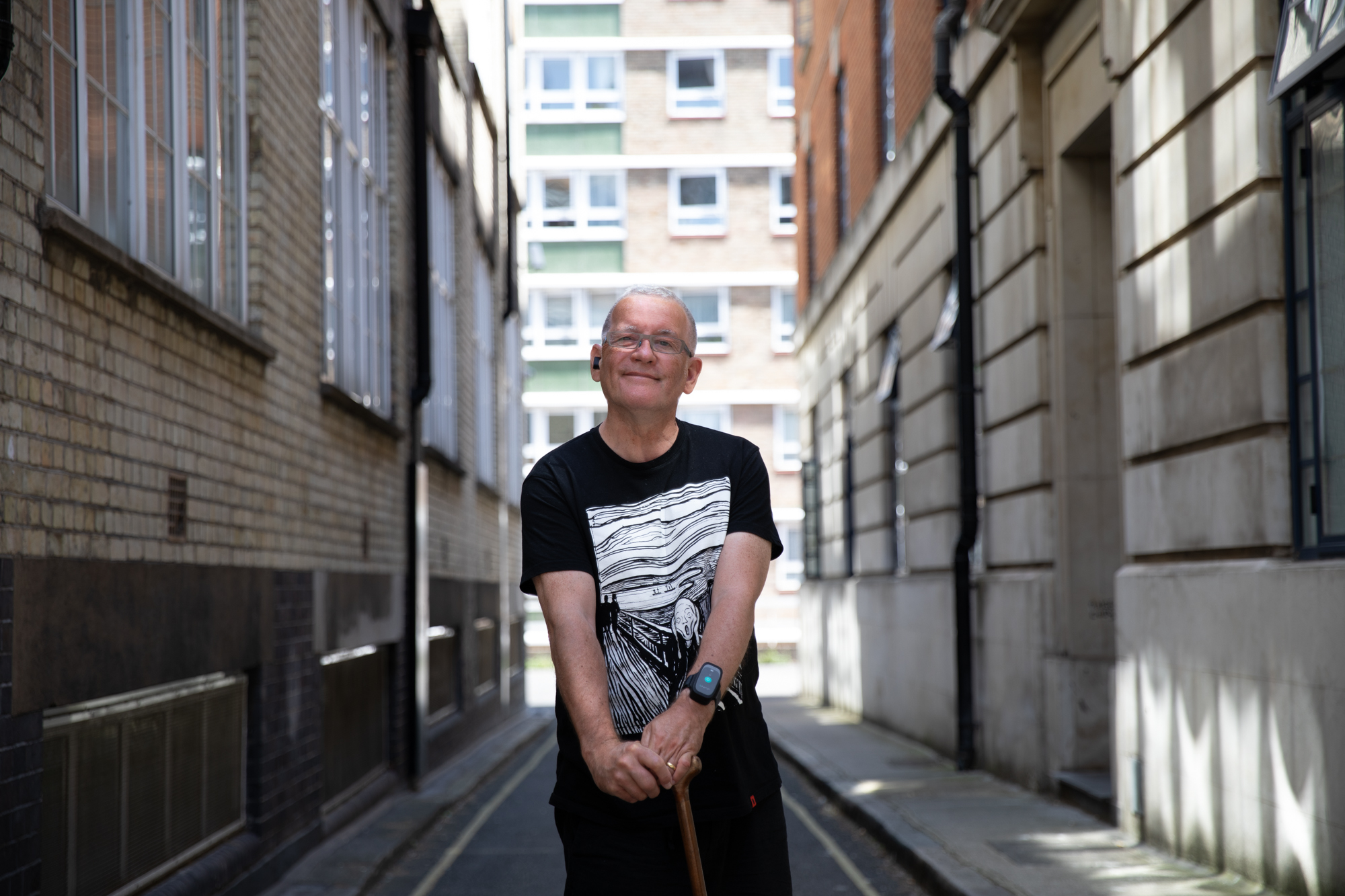
The June wearable device — a discreet wristband with teal indicator, paired with an in-ear stimulator.
The deviceWristband + earphone
Clinical partner
UCL Queen Square Institute of Neurology
Backed by
UKRI · Venrex · Mayor of London
Recognition
UKRI Future Leaders Fellowship
Stage
Piloting with patients now
01 · The problem

120 lives destroyed
by a stroke, every 10 minutes.

Most survivors never regain use of their hand. Existing rehab is reserved for those who have already moved — leaving a silent majority stuck in the gap between hospital discharge and recovery.

02 · Clinical evidence

Clinically proven,
sustained recovery.

Validating in ongoing clinical studies at Queen Square Institute of Neurology — the UK's leading centre for neurorehabilitation.
32%
regained new movement
after just four hours of treatment
~3×
increase in MEP amplitude
triple the current gold standard
95%
of patients tested
saw a muscle response with the device
4 hrs
to restore movement
including patients who hadn't moved their hand in decades
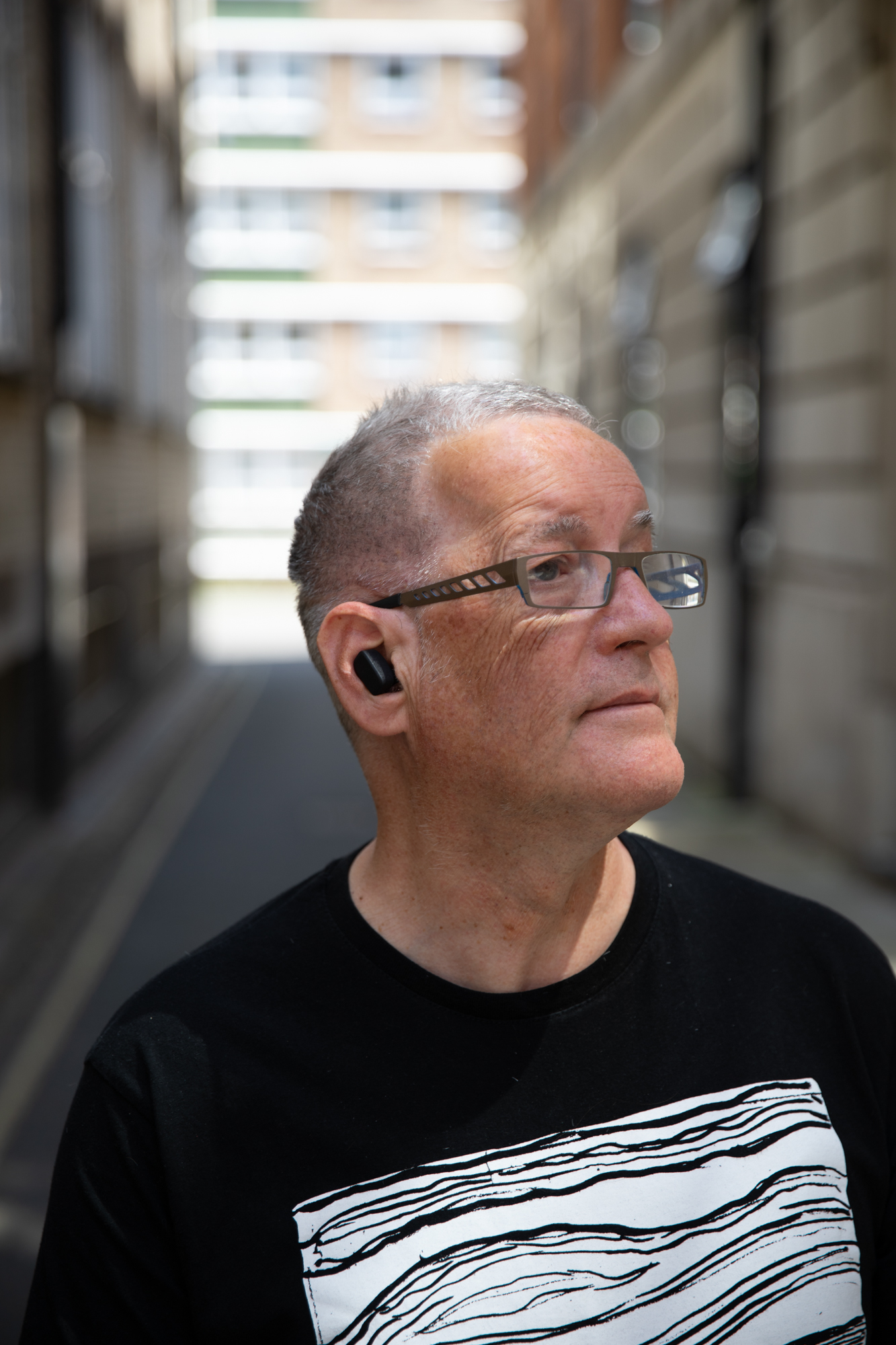
A stroke survivor wearing the June earphone stimulator during a treatment session.
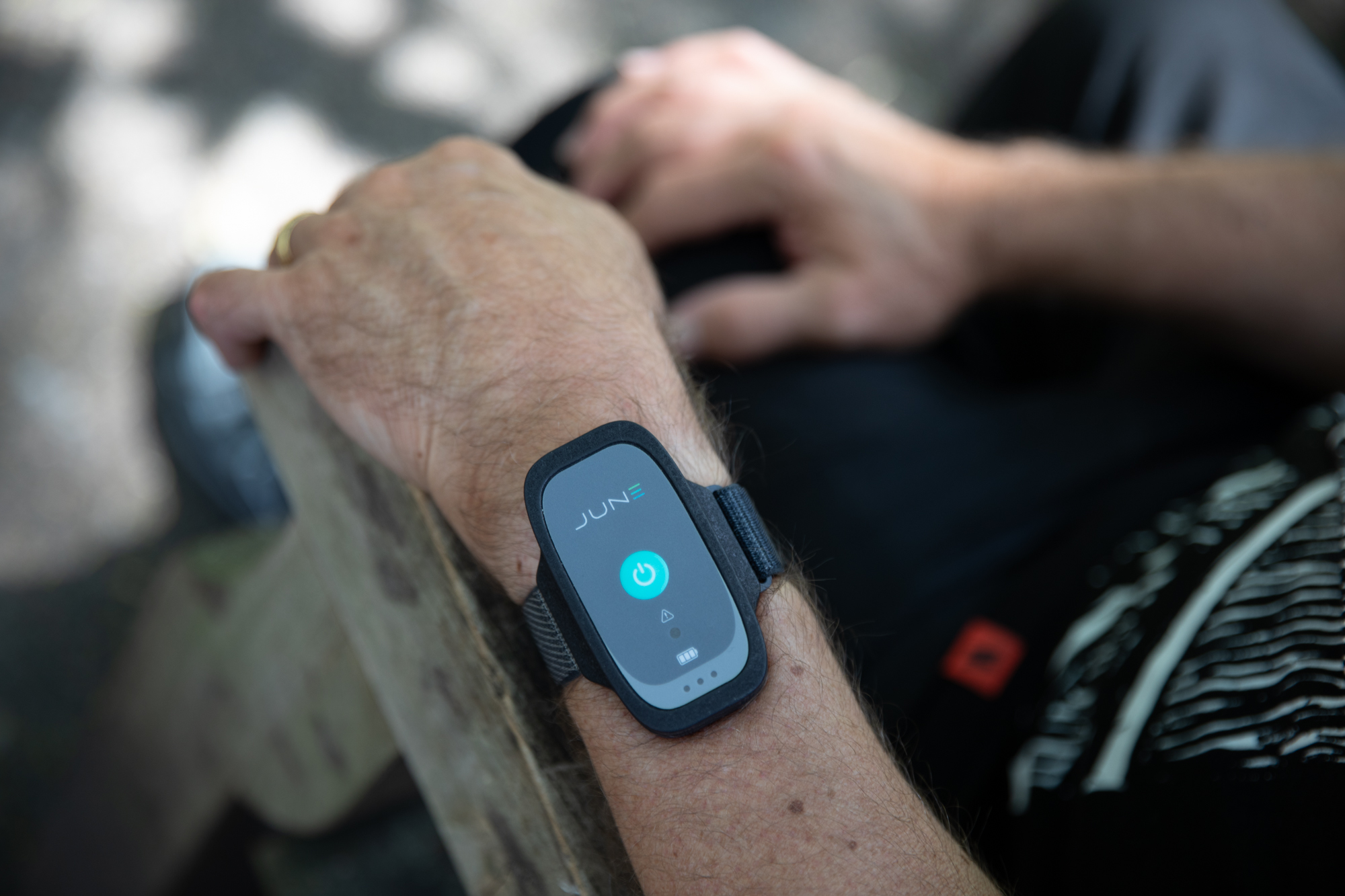
Close-up of the June-branded wristband worn on the forearm.
03 · The solution

Patented treatment.
Two precisely-timed stimuli.

June pairs a wearable wristband with a discreet earphone. Together they retrain the neural pathways that control the hand.

01

Wristband

A gentle tap to the wrist activates the muscles that control the fingers.

02

Earphone

A soft click delivered via earphone activates cells in the reticular formation, closing the loop.

03

Companion app

Progress is tracked session-by-session, giving clinicians and patients a shared view of recovery.

04 · How it works

Rewire.
Retrain.
Restore.

The June protocol pairs two stimuli with powerful inputs to the spinal cord and brain to rebuild brain–hand connection lost after stroke.

  1. 01
    Wristband tap
    A gentle tap delivers a brief electrical stimulus to the wrist.
  2. 02
    Stimulates finger muscles
    Activates the muscles that control the fingers and hand.
  3. 03
    Signal to spine
    The tap injects a powerful input from the hand up to the spinal cord.
  4. 04
    Earphone click
    A soft click is delivered to the opposite ear.
  5. 05
    Reticular formation
    The signal activates the reticular formation in the brainstem.
  6. 06
    Motor cortex
    The signal reaches the motor cortex, driving movement intention.
  7. 07
    Signal back to hand
    Motor signals travel down the spine to the hand, strengthening the pathway.
  8. 08
    Repeated loop
    The cycle repeats hundreds of times, reinforcing neural connections.
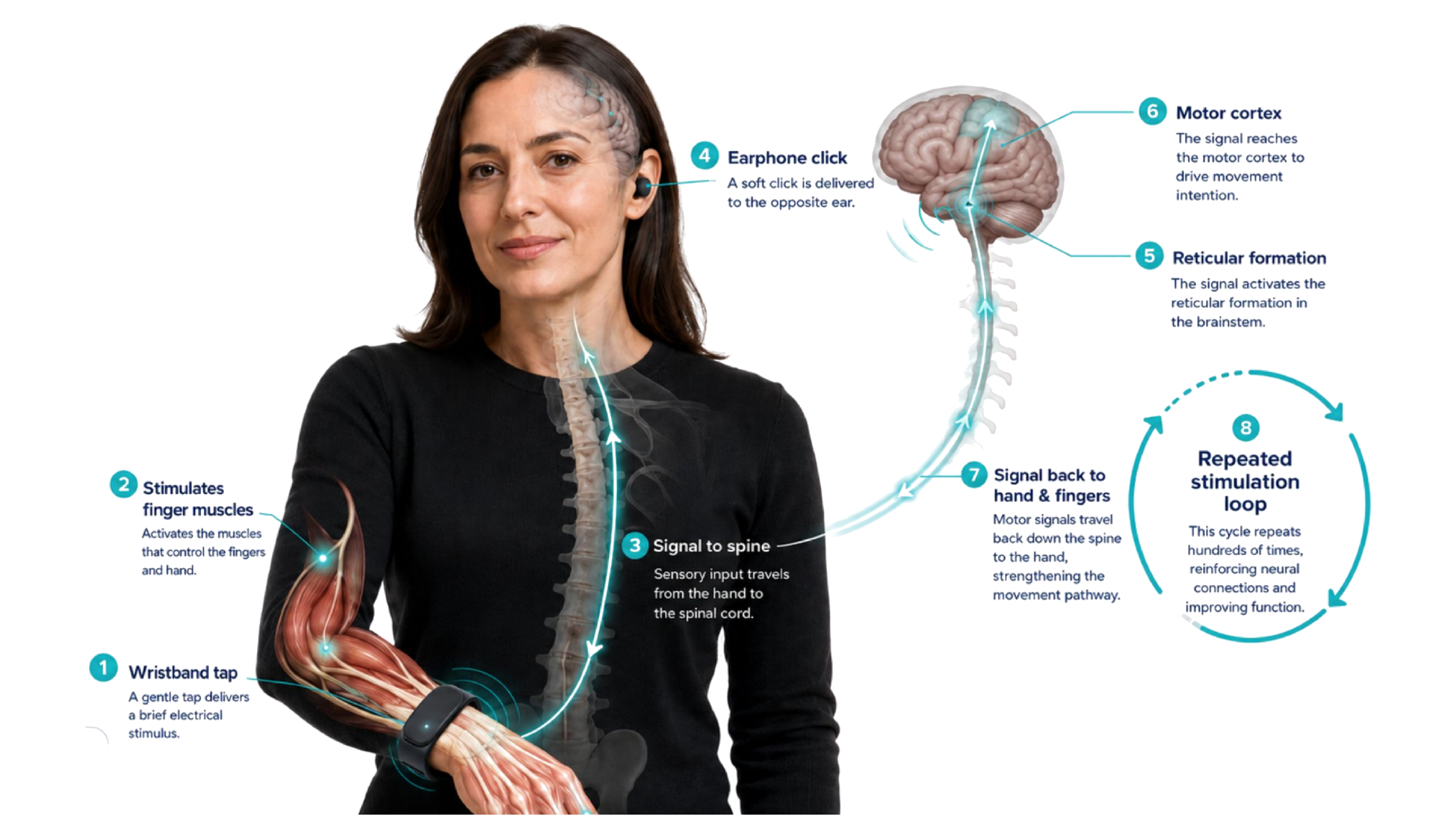
June's Rewire, Retrain, Restore stimulation loop — wristband tap, earphone click, and the neural pathway back to the hand.
05 · The pathway

Disrupting a global
healthcare system.

June fills the gap between hospital discharge and formal rehab — unlocking recovery for patients who would otherwise be told to wait.

01
Hospital discharge
Life saved.
02
The gap
Too early for conventional rehab.
03
June
Builds the first movement.
04
Ready for therapy
Foundation for rehab.
05
Recovery
Return to independence.
06 · For clinics

Creating value across the system.

June is designed for the reality of a busy neuro clinic — a small, wearable protocol that slots into existing workflows.

Book a clinical conversation
Patients
Right-level treatment
Meet patients in the recovery gap, before they're ready for conventional therapy.
Physios
Treat more patients
Extend clinical capacity — one physio can supervise multiple June sessions in parallel.
Clinics
More reach + revenue
Add a differentiated, revenue-generating service that unlocks a new patient cohort.
07 · Competitive edge

The only wearable
restorative protocol.

01
Serve the 40% of stroke survivors currently unmet by rehab.
02
Extend the reach of every existing rehab team.
03
Simple, low-cost, scalable — deployable across clinic and, ultimately, home.
Restorative
Assistive
Home-deployable
Clinic-only
Myomo
Saebo
Neofect
Tyromotion
Hocoma
Fourier
June
08 · Team

Decades of experience,
combined.

A team of clinicians, neuroscientists, and engineers — supported by a network of world-class advisors.
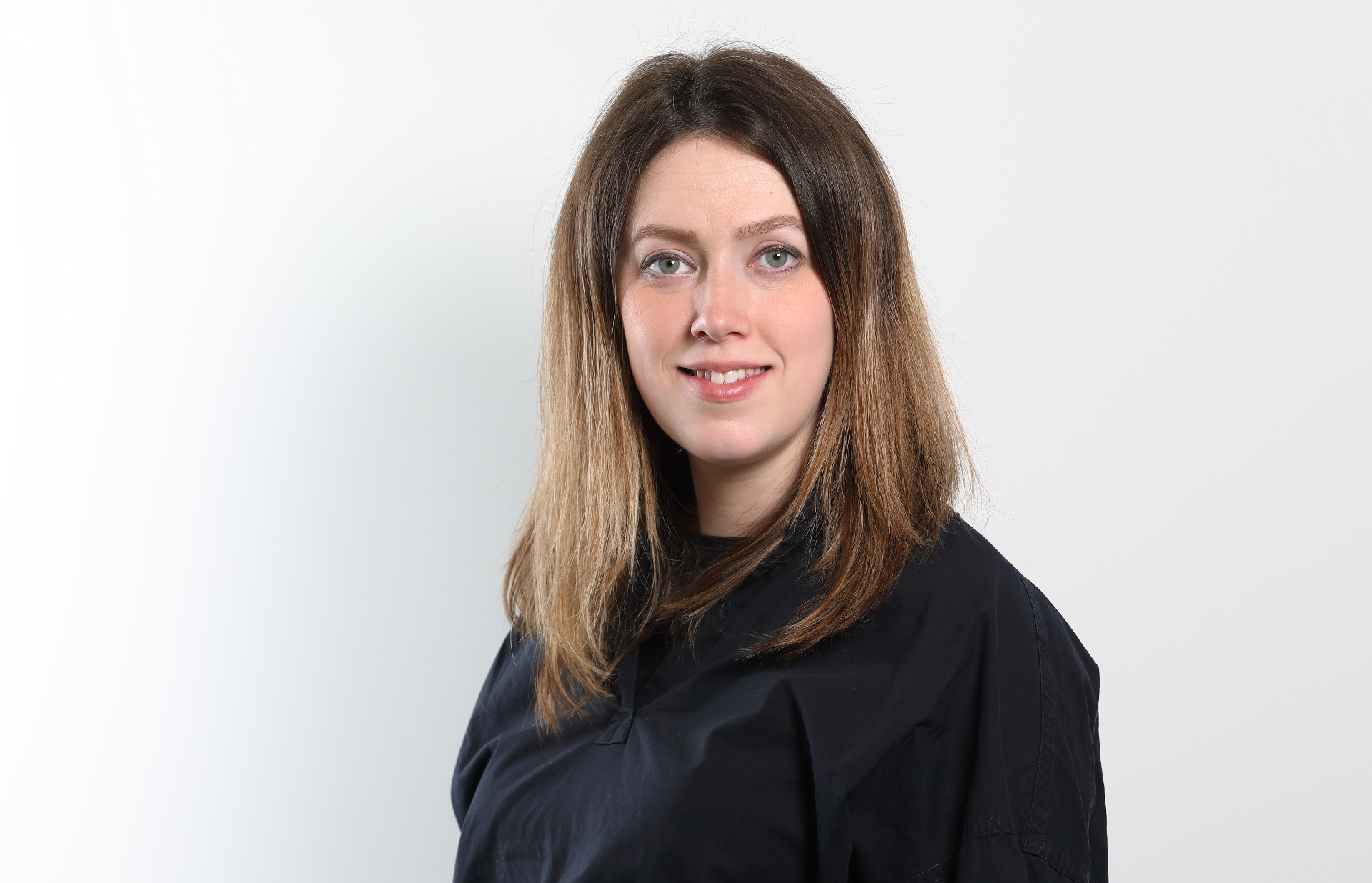
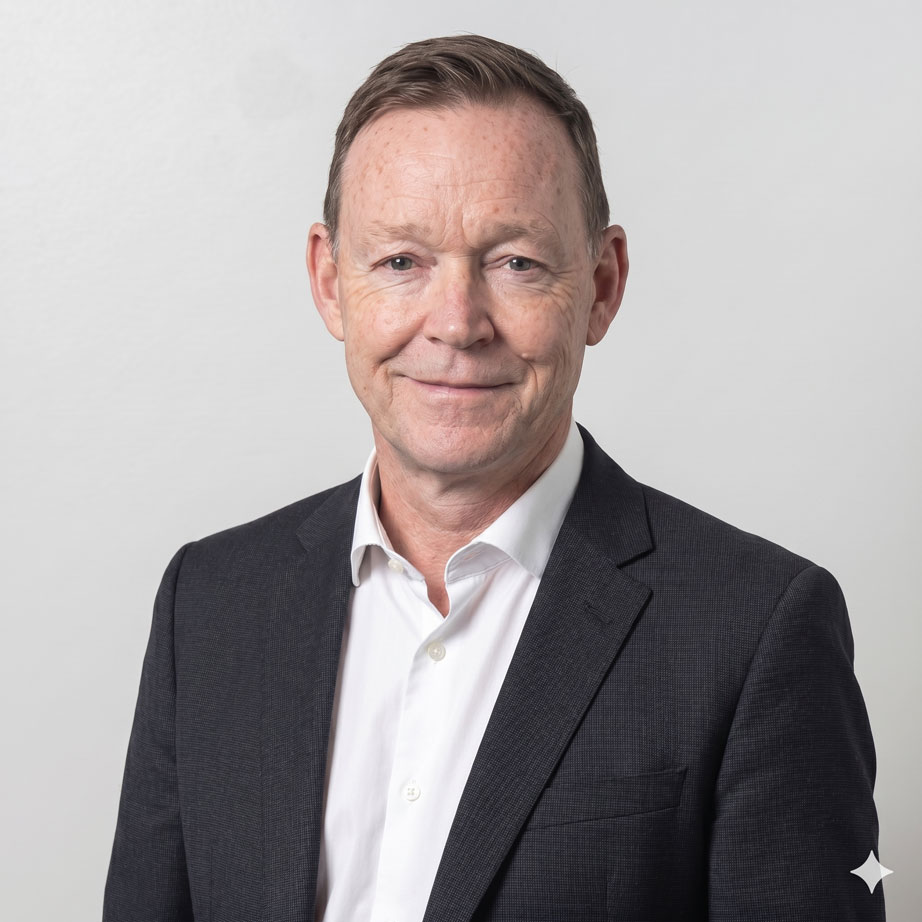
Portrait of Dr Laura Salisbury, Founder & CEO at June.
Dr Laura Salisbury
Founder & CEO
PhD, UKRI Future Leaders Fellow. Named inventor on granted patents. Winner of the Mayor's Entrepreneur Award for Health.
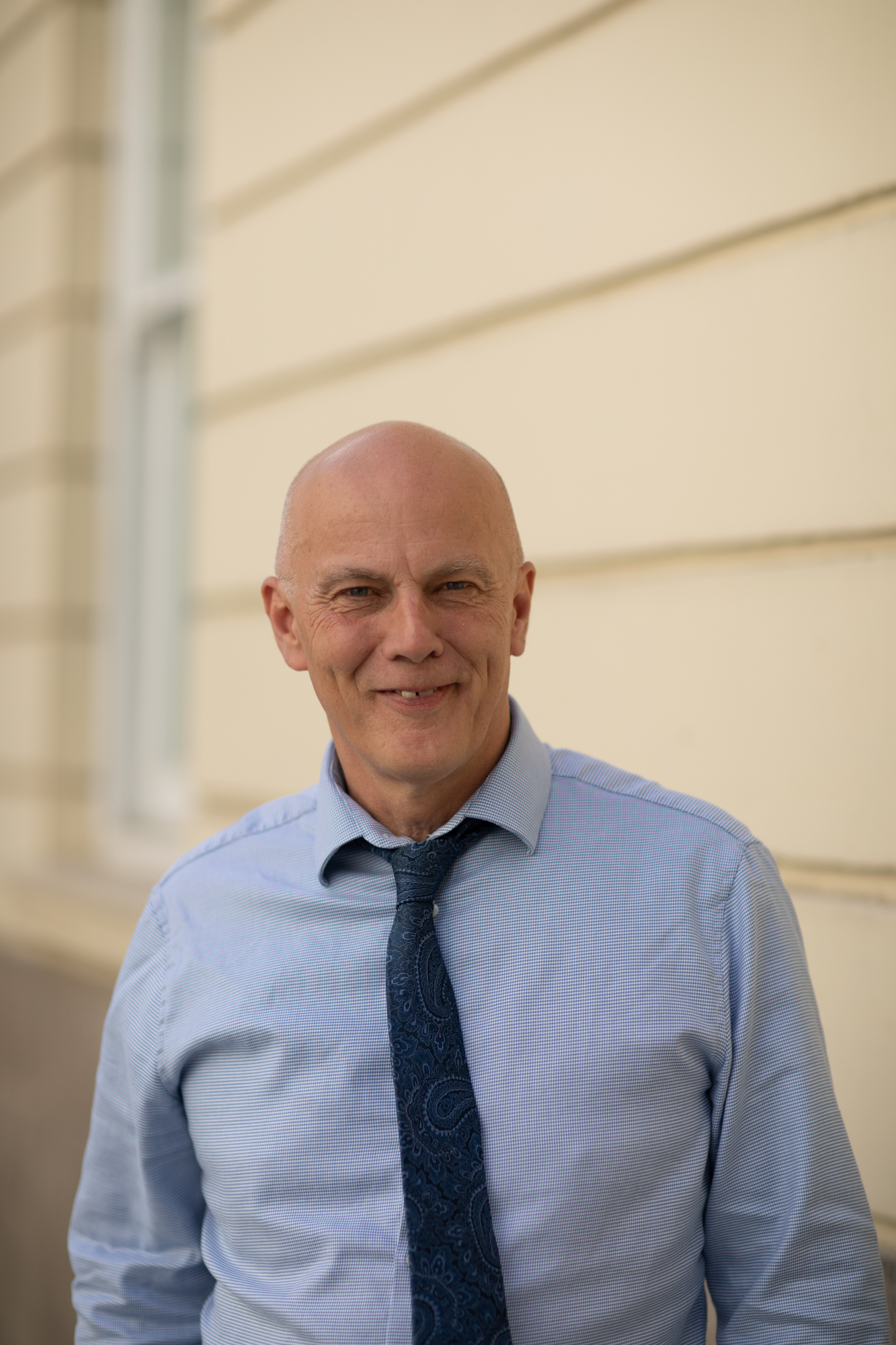
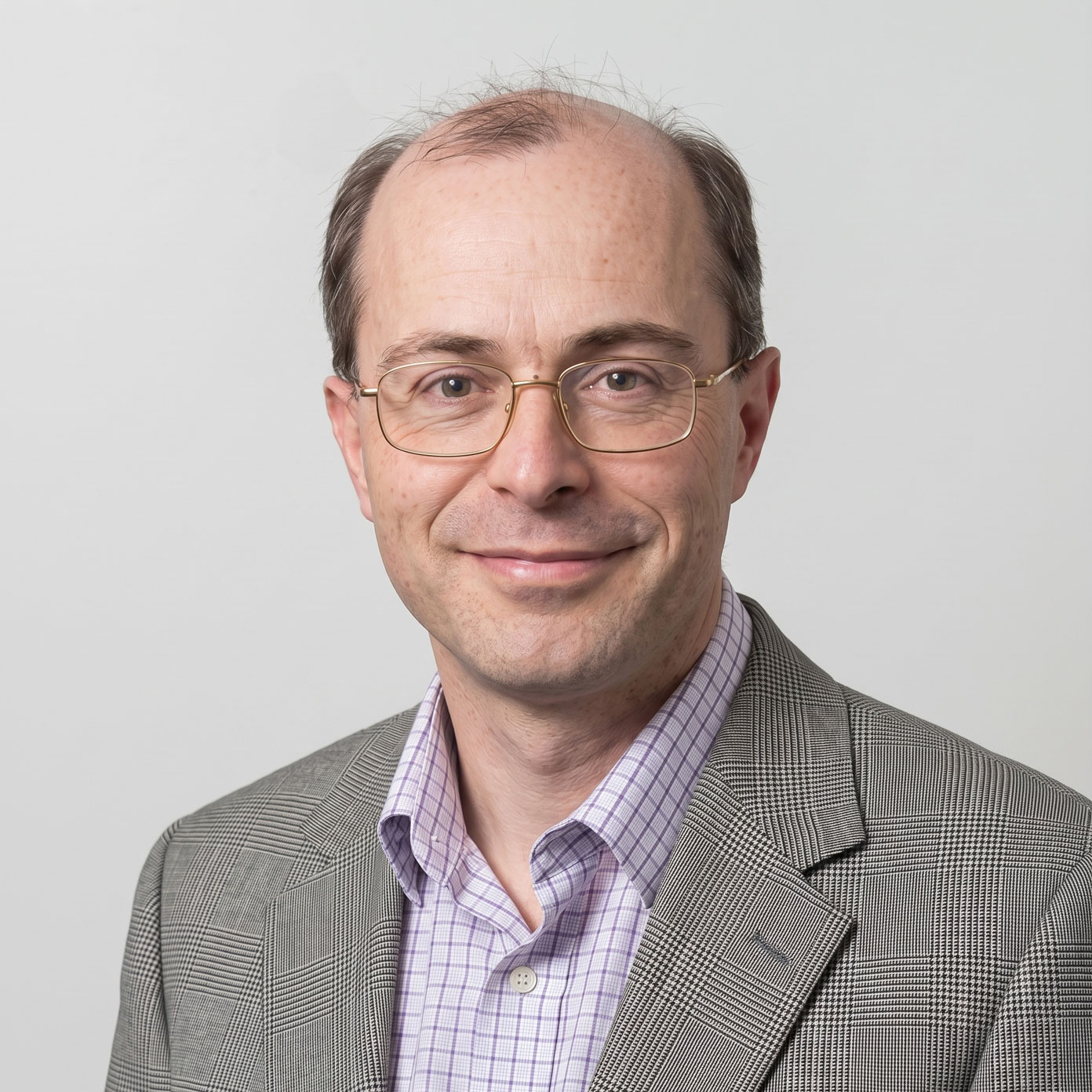
Portrait of Professor Stuart Baker, Neuroscience Lead at June.
Professor Stuart Baker
Neuroscience Lead
Leading figure in stroke research driving the neuroscience at June. PhD, University of Cambridge.
Portrait of Professor Nick Ward, Clinical Lead at June.
Professor Nick Ward
Clinical Lead
Professor of Clinical Neurology and Neurorehabilitation, UCL. Chair, Scientific Committee of the International Stroke Recovery and Rehabilitation Alliance.
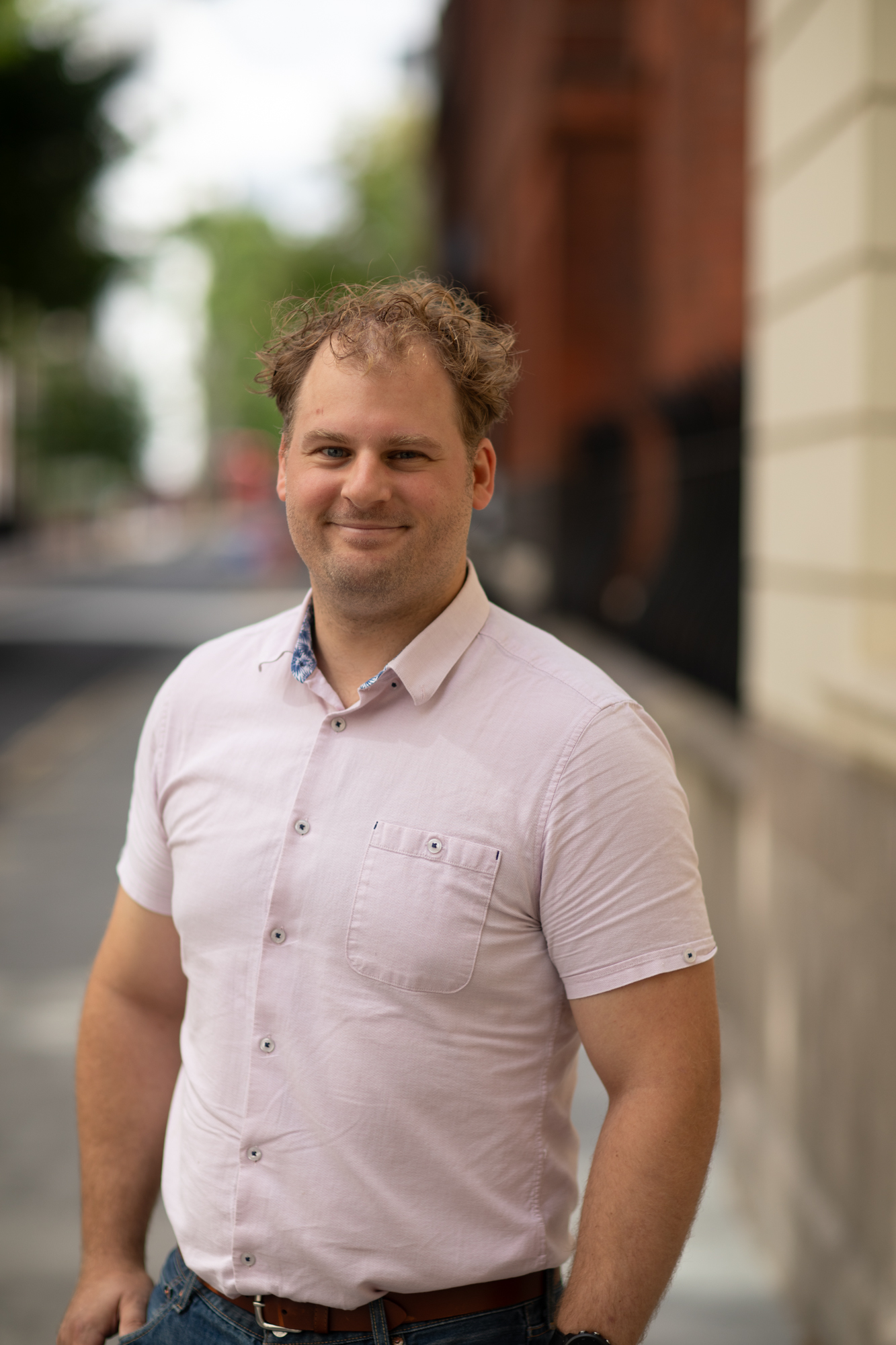
Portrait of Steve Young, Project Manager at June.
Steve Young
Project Manager
25+ years taking medical devices through complex manufacturing and regulatory pathways.
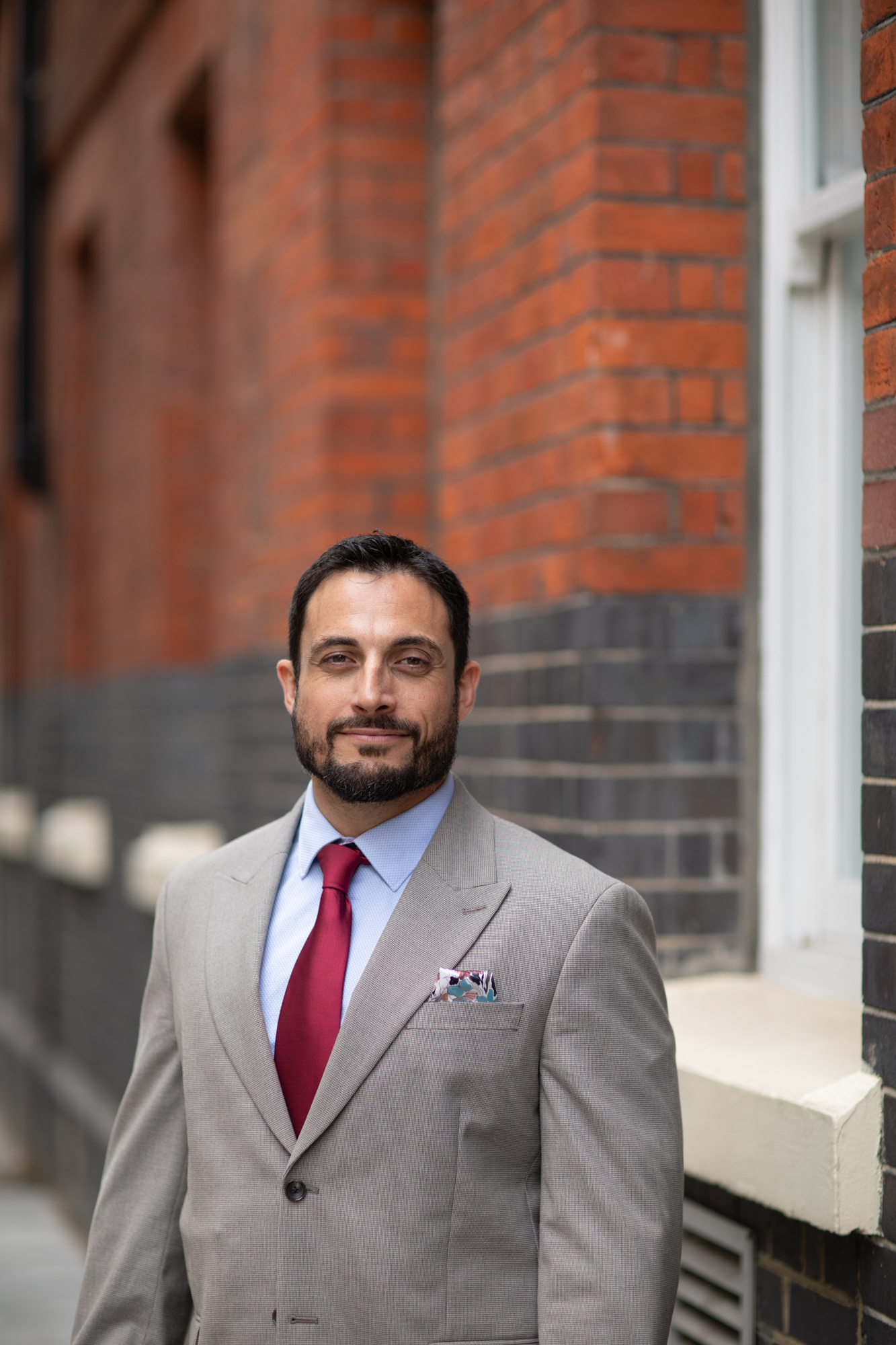
Portrait of Aaron Bater, Project Engineer at June.
Aaron Bater
Project Engineer
13 years in the medical sector, from manufacturing to medical-device development.
Portrait of Fabrizio Treccarichi, Technical Writer & Systems Engineer at June.
Fabrizio Treccarichi
Technical Writer & Systems Engineer
Engine performance simulation engineer with 7+ years of industrial experience.
Portrait of Athena Namboothiri, Clinical Research Assistant at June.
Athena Namboothiri
Clinical Research Assistant
Masters in Clinical Neuroscience at UCL.
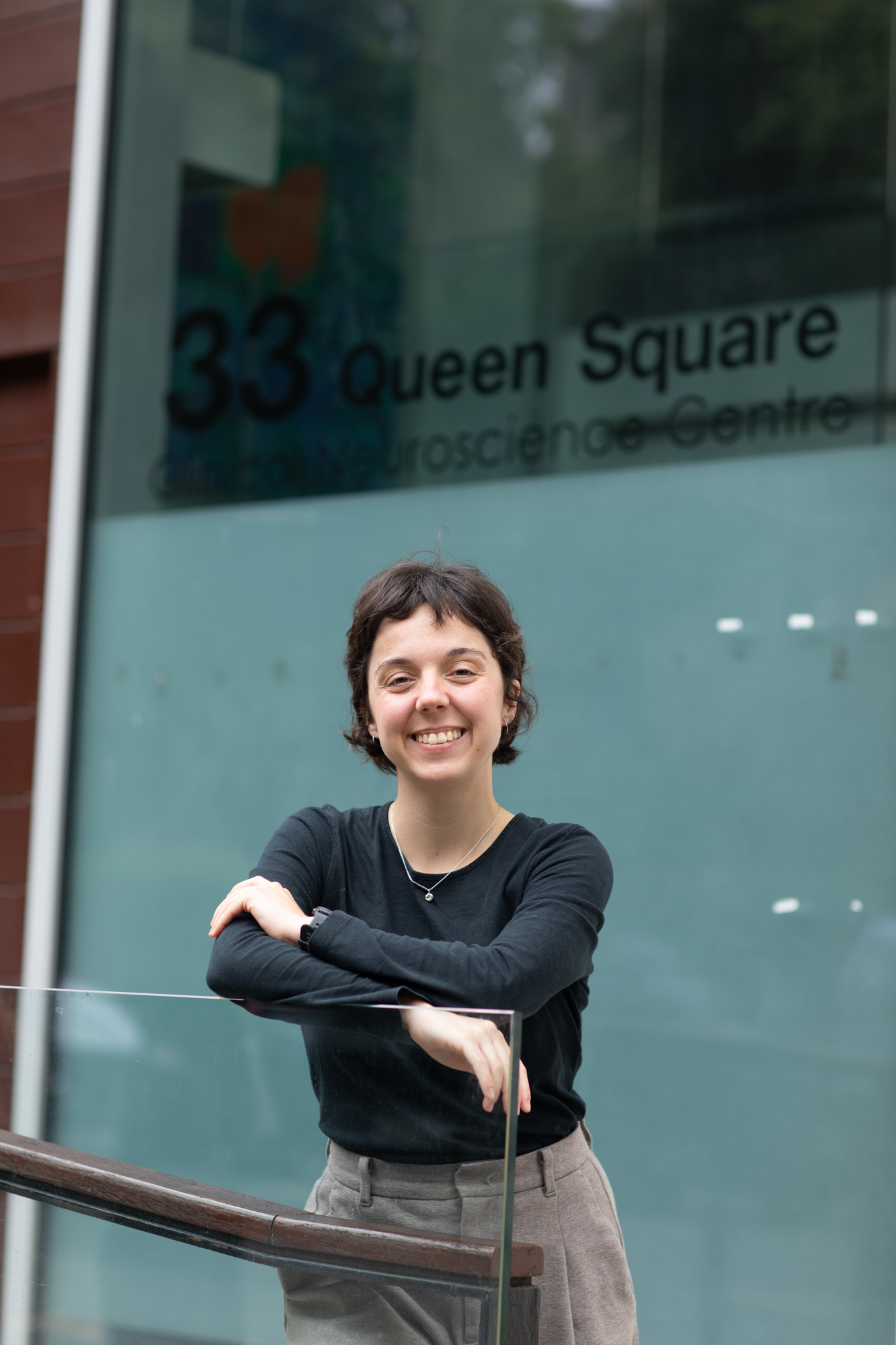
Portrait of Mireia Coll I Omana, Clinical Scientist & Physiotherapist at June.
Mireia Coll I Omana
Clinical Scientist & Physiotherapist
Neurorehabilitation specialist bridging clinical practice and applied research.
Portrait of Adrija Das, Research Assistant at June.
Adrija Das
Research Assistant
Supporting clinical study delivery at Queen Square Institute of Neurology.
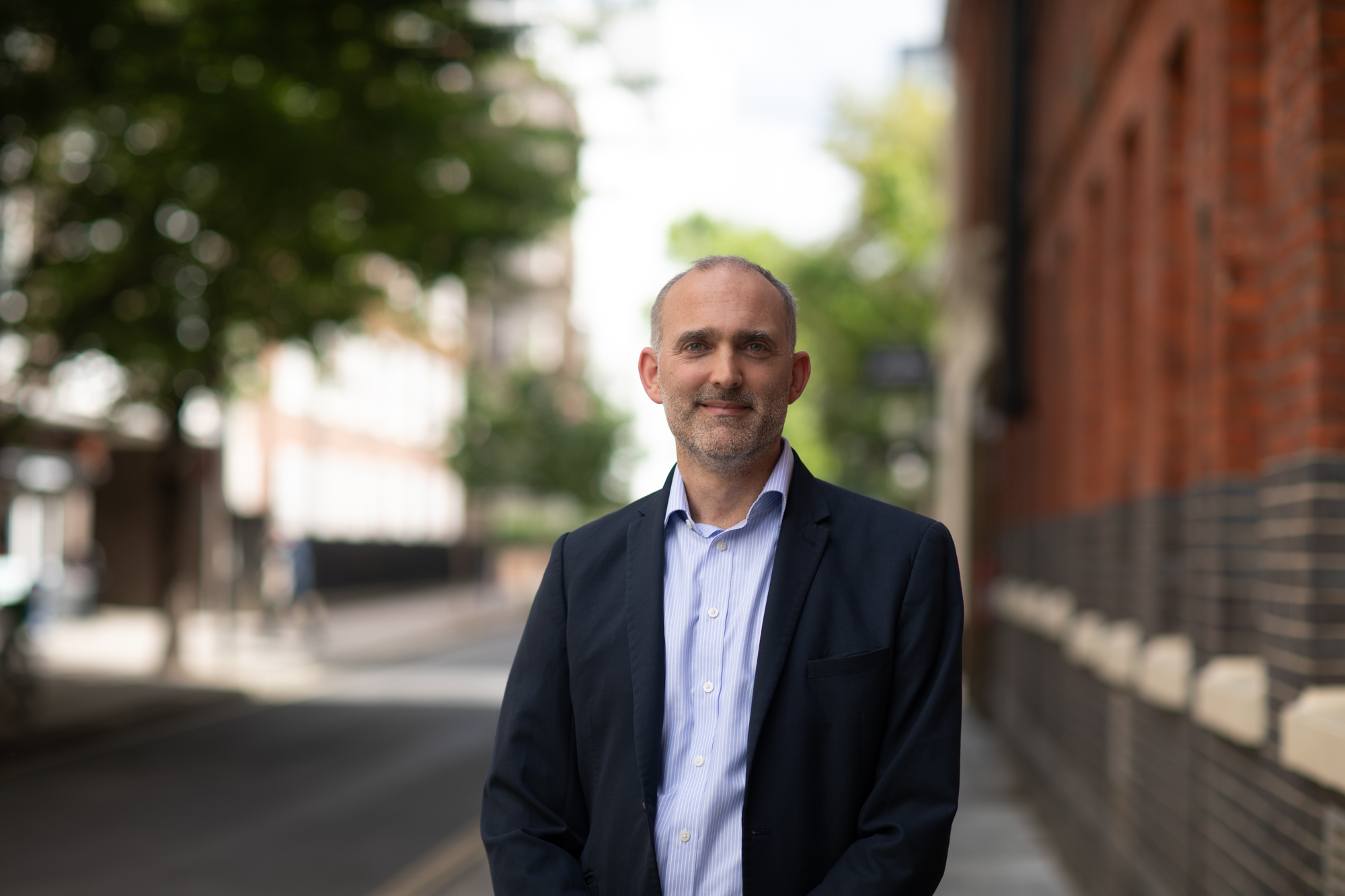
Portrait of Ian Watson, Software Regulatory Advisor at June.
Ian Watson
Software Regulatory Advisor
Regulatory specialist guiding June's software through medical-device compliance.
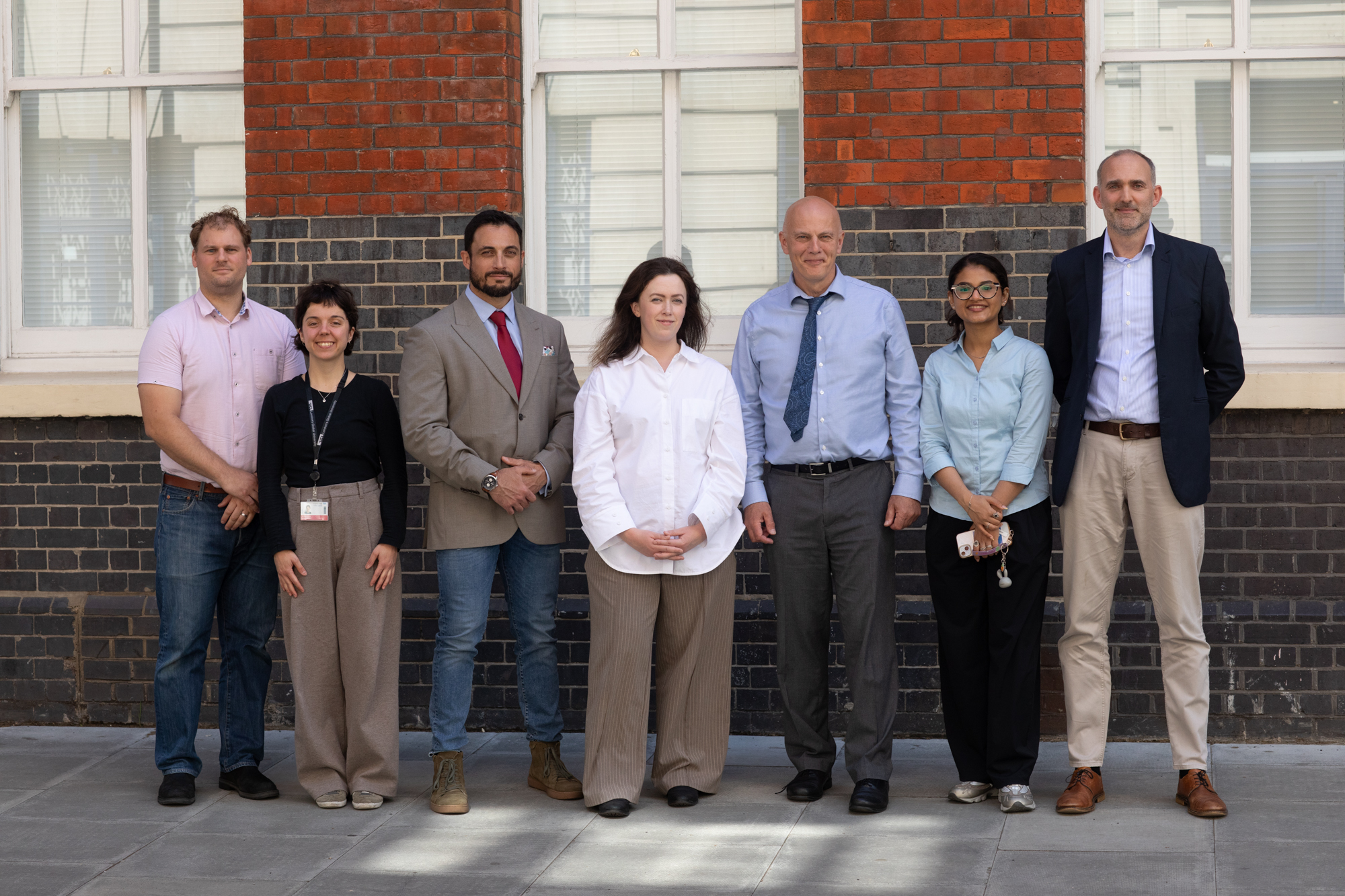
The June team outside their London offices.

…supported by a team of world-class advisors.

09 · For investors

A £100B+ neurorecovery opportunity.

Beachhead market → category creation → platform expansion. Three converging markets, one platform.

$10B
Neuromodulation
$20B
GLP-1 adjunct
$60B
Healthy ageing

Each vertical is multi-billion in its own right. Together they define a new category. *2025 figures

$125B+
Global neurorecovery spend
$21B+
Strategic buyer + provider annual spend

Request the deck

Get the full investor presentation with financials, roadmap, and use of funds.

Request the deck
Backed by
UKRI Future Leaders Fellowship
UCL Queen Square / UCLH
Venrex
Mayor of London
Grow London
10 · Contact

Let's rebuild
movement, together.

Whether you run a rehab clinic, work in stroke recovery, or want to invest in this next chapter — we'd love to hear from you.

Direct
laura@junemovement.com
Dr Laura Salisbury · Founder & CEO